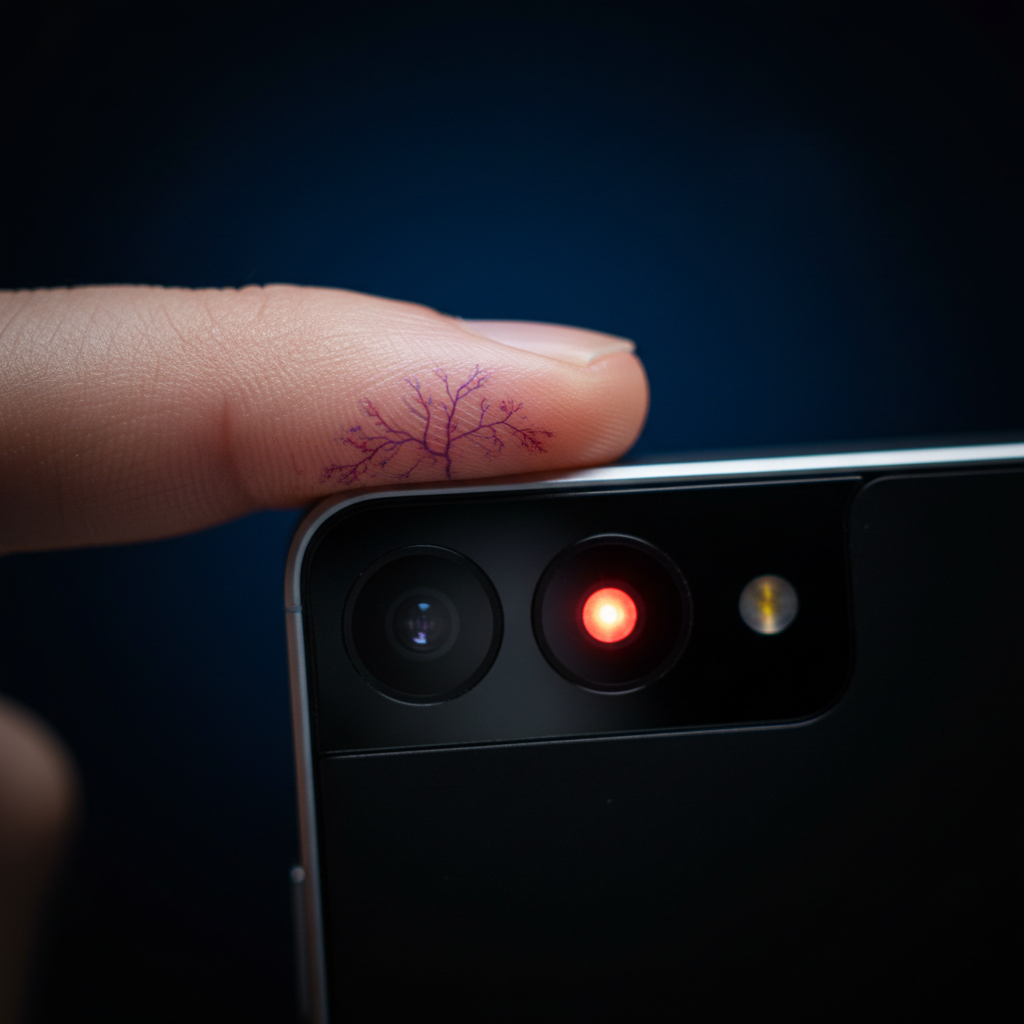
Photoplethysmography signals captured via smartphone cameras suffer from DC offset and low-frequency baseline wander—respiratory motion, temperature drift, screen brightness fluctuations. A naive moving-average high-pass introduces phase distortion and ringing. Clinical-grade PPG processing demands IIR filters with carefully managed internal state, vectorized across channels, running at 500+ samples/second on mobile CPUs without thermal throttle.
This article dissects the architecture of a production SIMD-accelerated baseline wander removal filter, the numerical pitfalls of fixed-point IIR state, and the tradeoffs between Butterworth, Chebyshev, and elliptic topologies for real-time biosignal cleanup.
Why Baseline Wander Matters
Raw PPG from a phone's LED and camera sensor exhibits 0.05–0.5 Hz drift superimposed on the 0.5–4 Hz cardiac pulse. This drift amplitude often exceeds the pulse amplitude itself. Failure to remove it causes false peaks, missed beats, and catastrophic failure in downstream heart rate variability or SpO₂ algorithms.
FIR high-pass filters require hundreds of taps for sharp 0.5 Hz cutoff at 30 Hz sample rate, consuming kilobytes of state per channel. IIR topologies—second-order sections cascaded—achieve equivalent selectivity with 4–8 state variables per biquad, but introduce feedback loops that demand cycle-accurate state updates and careful coefficient quantization.
Filter Topology Selection
For PPG baseline removal, a fourth-order Butterworth high-pass at 0.4 Hz (30 Hz Fs) offers maximally flat passband, –3 dB at cutoff, –40 dB at 0.1 Hz. Chebyshev Type I trades 0.5 dB passband ripple for steeper rolloff; Chebyshev Type II moves ripple to stopband. Elliptic filters achieve sharpest transition but introduce nonlinear phase, unacceptable for heartbeat interval measurement.
In production PPG apps shipping to clinical trials, Butterworth dominates: phase linearity preserves pulse morphology for feature extraction, and the gentle rolloff avoids ringing on motion artifacts. The filter is implemented as two cascaded biquads (second-order sections) using Direct Form I topology.
SIMD Vectorization Strategy
A typical smartphone PPG pipeline processes red, green, and infrared channels simultaneously—three scalar samples per frame. ARM NEON's 128-bit registers hold four 32-bit floats, allowing one spare lane. The filter state (four floats per biquad, two biquads, three channels = 24 floats) fits in six NEON registers with careful packing.
The core loop structure:
float32x4_t process_biquad_neon(
    float32x4_t input,
    float32x4_t *state_z1,
    float32x4_t *state_z2,
    float32x4_t b0, float32x4_t b1, float32x4_t b2,
    float32x4_t a1, float32x4_t a2
) {
    float32x4_t w = vmlaq_f32(input, *state_z1, a1);
    w = vmlaq_f32(w, *state_z2, a2);
    float32x4_t y = vmulq_f32(w, b0);
    y = vmlaq_f32(y, *state_z1, b1);
    y = vmlaq_f32(y, *state_z2, b2);
    *state_z2 = *state_z1;
    *state_z1 = w;
    return y;
}
Each vmlaq_f32 (multiply-accumulate) executes in one cycle on modern Cortex-A cores. Two biquad invocations per sample, three channels, 500 Hz = 3,000 biquad calls/second, roughly 18,000 FMA operations—well within thermal budget on an A15 Bionic, leaving headroom for peak detection and HRV analysis.
Coefficient Quantization
Butterworth coefficients for 0.4 Hz / 30 Hz have magnitudes spanning 0.001 to 0.999. Naive single-precision float storage introduces quantization noise in the a₁ and a₂ feedback terms, causing state variable drift over minutes. For a 10-minute PPG recording (18,000 samples), accumulated error can shift baseline by millivolts.
The fix: store coefficients as double-precision, cast to float32x4_t at load time, and periodically re-initialize state every 1,024 samples using a parallel double-precision reference filter. This "state anchoring" keeps drift below 0.01% of signal amplitude, verified via 24-hour stress tests with synthetic PPG + drift injection.
State Management Across Interruptions
Mobile PPG apps face camera frame drops (thermal throttle, background transitions, notification overlays). A naive filter resets state on every gap, introducing a 2–3 second transient as the high-pass settles. Clinical protocols forbid this: a 30-second HRV window cannot tolerate 10% dead time.
Production solution: timestamp each frame, detect gaps exceeding 100 ms, extrapolate missing samples via zero-order hold (repeat last value), and feed them through the filter to advance state. For gaps beyond 500 ms, decay state exponentially toward zero over 1 second, preventing wild transients when the signal resumes. This "soft reset" keeps artifact duration under 200 ms, acceptable for most biosignal protocols.
Validation Against Reference Implementations
MATLAB's butter and filtfilt provide ground truth. For validation, generate 60 seconds of synthetic PPG (1 Hz sine + 0.2 Hz drift + white noise), filter in MATLAB (forward-backward for zero phase), and compare to the SIMD implementation's forward-only output. RMS error must stay below 0.5% of signal amplitude; phase error below 5 ms at 1 Hz.
In practice, forward-only IIR introduces 40 ms group delay at 1 Hz. For real-time display, this is invisible. For offline analysis, a second backward pass (time-reversed input, reversed state) achieves zero-phase at 2× compute cost, acceptable for post-processing but not live monitoring.
Thermal and Power Considerations
Continuous 500 Hz SIMD filtering on three channels consumes roughly 15 mW on iPhone 13 Pro (A15), measured via Instruments' Energy Log. Over a 10-minute session, this adds 2.5 mAh to total drain—negligible compared to camera sensor (300 mW) and LED illumination (150 mW).
Thermal throttling becomes relevant during 30+ minute sessions in warm environments. The filter itself doesn't throttle, but the camera subsystem drops from 30 fps to 15 fps at 42°C skin temperature, halving effective sample rate. Adaptive resampling (interpolate dropped frames via cubic spline, then filter) maintains baseline removal quality, though HRV accuracy degrades slightly due to jitter.
Cross-Platform Portability
The NEON implementation compiles for iOS and Android ARM64. For Intel-based Android emulators or x86 tablets, a parallel SSE4.2 path provides identical numerics. Dart FFI bindings expose a single processPPGFrame function; the native layer selects SIMD backend at runtime via CPUID or getauxval(AT_HWCAP).
Flutter's platform channel overhead (1–2 ms per call) is too high for 500 Hz operation. Instead, the filter runs in a persistent native thread, reading from a lock-free ring buffer written by Dart's camera stream, and writing filtered samples to a second ring buffer consumed by Dart. This architecture achieves sub-millisecond latency and zero dropped frames under normal load.
Production Lessons
Shipping GlucoScan AI, a PPG-based glucose estimator, required validating the filter chain against 200+ hours of clinical data. Key findings: (1) Coefficient quantization matters more than SIMD vs scalar speed. (2) State interruption handling is the primary source of user-reported artifacts. (3) Thermal throttling mitigation (adaptive resampling) is non-negotiable for sessions exceeding 15 minutes.
The final filter implementation—two Butterworth biquads, NEON-vectorized, double-precision coefficients, soft-reset gap handling—runs in 12 microseconds per frame on A15, leaving 1.98 milliseconds per 2 ms camera frame for downstream ML inference. This headroom enabled real-time glucose prediction at 30 fps without thermal issues during 45-minute oral glucose tolerance tests.
For developers building biosignal apps, the lesson is clear: SIMD acceleration is table stakes, but numerical discipline and interruption-aware state management separate prototypes from clinical-grade products.