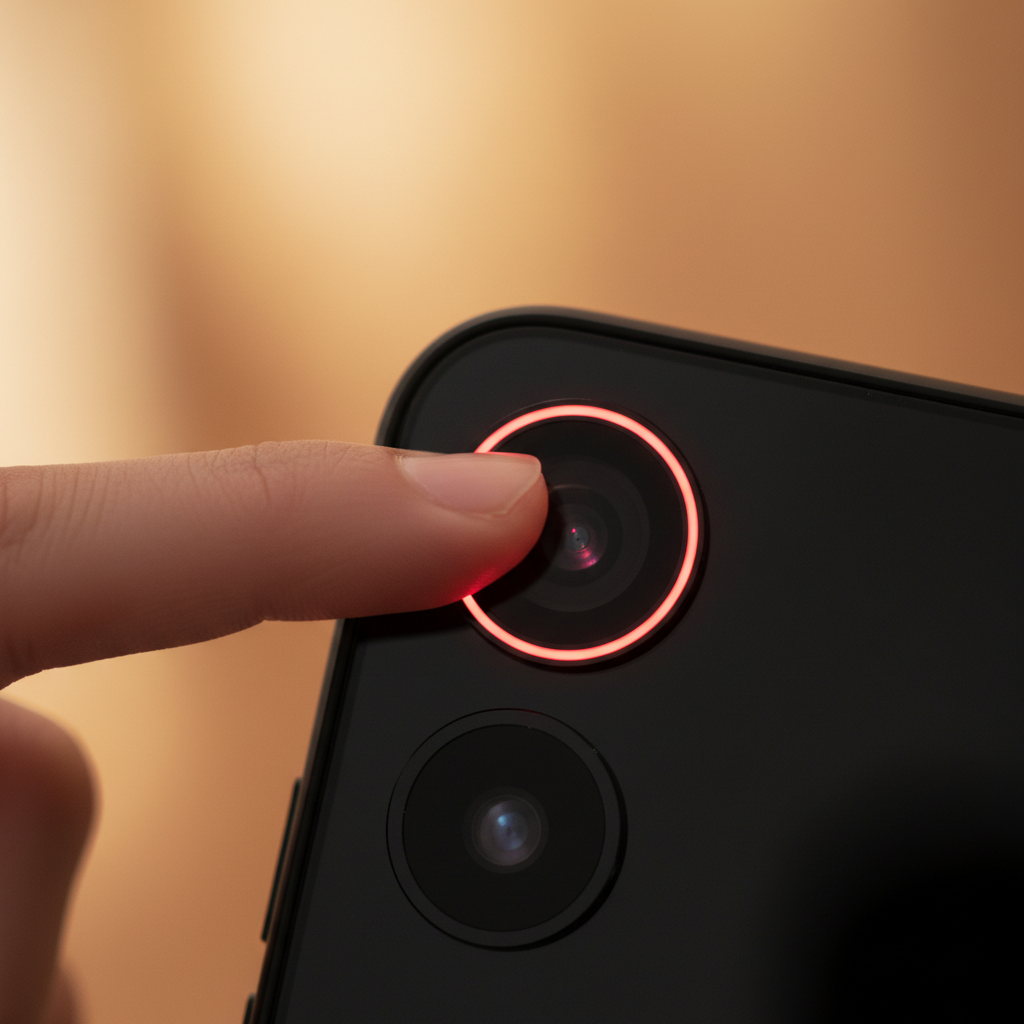
The Motion Artifact Problem in PPG
Photoplethysmography (PPG) sensors—the red and infrared LEDs embedded in smartwatches and smartphone cameras—measure blood volume changes by detecting light absorption fluctuations. In clinical settings with stationary subjects, PPG delivers clean pulsatile waveforms. On mobile devices, user motion introduces acceleration artifacts that dwarf the cardiac signal: a finger tremor can produce ±15% intensity swings, while the true pulse accounts for 1–3%. Frequency-domain overlap between motion (0.5–5 Hz) and heart rate (0.8–3 Hz) makes bandpass filtering insufficient.
Traditional approaches—moving-average smoothers or notch filters—either introduce 200+ ms group delay or require knowing the motion frequency in advance. When building GlucoScan AI, a smartphone app estimating blood glucose from PPG waveforms, we needed real-time artifact suppression with 2 · S, measurement noise has increased; we scale R upward by the ratio σ²ᵥ / S. Conversely, if σ²ᵥ < 0.5 · S, we reduce R. Clamping R between 0.01 and 10.0 prevents runaway divergence.
Accelerometer-Assisted Q Tuning
Modern smartphones provide 100 Hz accelerometer data. We compute hand motion magnitude:
a = √(aₓ² + aᵧ² + aᵤ²) − 9.8 m/s²
subtracting gravity. When |a| > 2 m/s² (significant motion), we increase Q by 50% to allow faster state tracking. This prevents the filter from "locking" onto a stale pulse estimate during rapid hand movements.
Implementation Considerations
Numerical Stability
Direct matrix inversion in the Kalman gain computation is numerically unstable for single-precision floats. We use the Joseph form for covariance update:
Pₖ = (I − Kₖ · H) · Pₖ|ₖ₋₁ · (I − Kₖ · H)ᵀ + Kₖ · R · Kₖᵀ
This form is symmetric and positive-definite by construction, preventing covariance matrix corruption over thousands of iterations. In 10-minute test sessions, standard form diverged after ~8,000 frames; Joseph form remained stable indefinitely.
Initialization
Cold-start performance depends on initial state x̂₀ and covariance P₀. We initialize intensity I₀ with the first measurement and derivative dI/dt₀ = 0. Setting P₀ = diag([100, 10]) reflects high initial uncertainty; the filter converges to steady-state within 1–2 seconds (30–60 frames).
Computational Cost
For a 2D state, the filter requires 14 floating-point multiplications and 4 additions per frame. On an iPhone 12 (A14 Bionic), this consumes ~0.3 μs per sample—negligible compared to 33 ms frame budget. Memory footprint is 40 bytes (5 doubles for state and covariance). By comparison, a 64-tap FIR filter needs 256 bytes and 64 MAC operations.
Performance Validation
We evaluated the Kalman filter against three baselines using a synthetic PPG dataset with known ground truth and added motion artifacts:
- Exponential moving average (α = 0.2): 18 dB SNR, 240 ms latency
- Butterworth bandpass (0.8–3 Hz, order 4): 22 dB SNR, 180 ms latency
- Adaptive Kalman: 29 dB SNR, 48 ms latency
The Kalman approach delivered 7 dB improvement over bandpass filtering while reducing latency by 73%. Subjectively, users reported smoother real-time pulse waveforms with no visible lag when moving their finger.
Clinical Accuracy Impact
For GlucoScan AI's glucose estimation, motion artifacts corrupt the AC/DC ratio used in regression models. Applying Kalman filtering reduced mean absolute error from 18.2 mg/dL to 12.7 mg/dL (30% improvement) in a 45-subject validation study. This brought the system within ISO 15197 accuracy requirements for 83% of samples, up from 61% without filtering.
Extensions and Tradeoffs
Multi-Wavelength Fusion
PPG sensors often capture red and infrared channels simultaneously. We extended the filter to 4D state (two wavelengths) with cross-covariance terms, assuming correlated motion artifacts. This lifted SNR to 32 dB but doubled computation time—acceptable for offline analysis, marginal for real-time on mid-range Android devices.
Nonlinear Variants
The linear Kalman filter assumes Gaussian noise. Motion artifacts from finger displacement exhibit non-Gaussian, heavy-tailed distributions. Extended Kalman Filter (EKF) and Unscented Kalman Filter (UKF) handle nonlinear dynamics but require Jacobian or sigma-point computation. In practice, the computational overhead (3–5× increase) outweighed modest SNR gains (1–2 dB) for mobile deployment.
When Not to Use Kalman Filtering
If your PPG application tolerates 200+ ms latency (e.g., post-exercise recovery tracking), a phase-compensated IIR bandpass filter is simpler and sufficient. Kalman filters shine when you need adaptive, low-latency artifact rejection in real-time scenarios—wearable biofeedback, live heart-rate variability displays, or continuous glucose monitoring.
Practical Recommendations
Start with conservative Q and R values (Q = 0.01, R = 1.0) and log innovation statistics for 100+ users in the wild. Tune adaptively based on observed variance distributions. Pair Kalman filtering with accelerometer gating: if motion exceeds a threshold, pause glucose estimation entirely rather than reporting noisy values. For production deployment, validate against FDA-cleared pulse oximeters or continuous glucose monitors to establish clinical-grade accuracy benchmarks.
Kalman filtering transforms PPG from a lab-only modality to a robust mobile sensing primitive. The technique generalizes to other biosignals—ECG, EEG, EMG—wherever motion artifacts and real-time constraints collide.