The Baseline Wander Problem in Mobile PPG
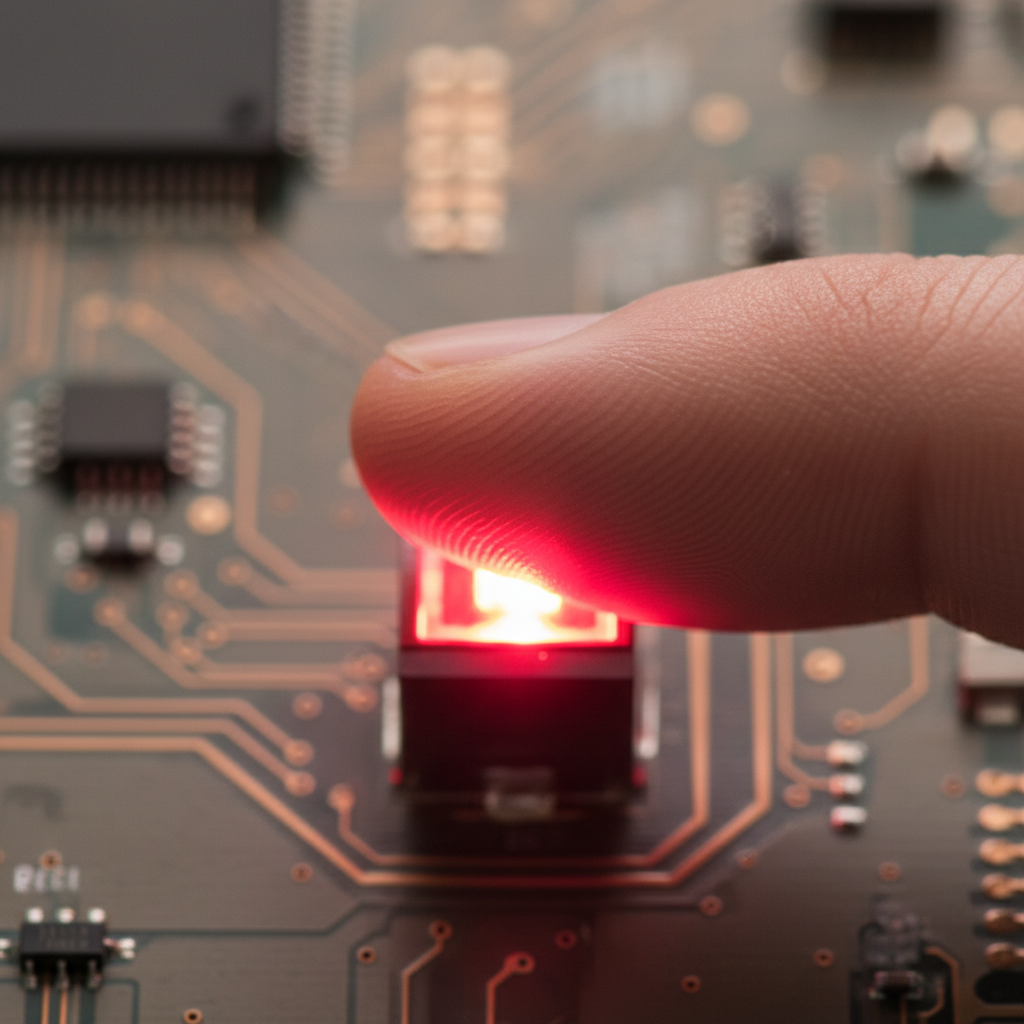
Photoplethysmography sensors measure blood volume changes by shining light through skin and detecting absorption. On mobile devices, PPG signals suffer from a slow-drifting DC component called baseline wander—caused by ambient light leakage, LED temperature drift, tissue pressure changes, and gross body motion. This wander sits in the 0.05–0.5 Hz band, overlapping the respiratory rate (0.15–0.4 Hz) and obscuring the AC pulse component needed for heart rate, SpO₂, or glucose inference.
Traditional high-pass FIR filters introduce group delay proportional to tap count. A 128-tap filter at 100 Hz sampling adds 640 ms latency—unacceptable for real-time feedback in apps like GlucoScan AI, where users expect instant visual confirmation that the sensor is correctly positioned. Brick-wall filters also ring on transients, creating false peaks that corrupt peak detection algorithms.
Exponential Moving Average as a First-Order IIR
An exponential moving average is the discrete-time equivalent of an RC high-pass filter. The difference equation is:
y[n] = α · x[n] + (1 - α) · y[n-1]
where α is the smoothing factor. The high-pass output is x[n] - y[n]. The 3 dB cutoff frequency is:
f_c = (f_s / 2π) · ln(1 / (1 - α))
For a 100 Hz sampling rate and 0.5 Hz cutoff, α ≈ 0.031. This requires only two floating-point operations per sample and one state variable—trivial overhead on ARM Neon or Apple AMX.
The phase response is nearly linear in the passband (0.5–50 Hz), introducing less than 20 ms group delay at 1 Hz. For a 60 bpm heart rate (1 Hz fundamental), this is 1.2° phase shift—negligible for systolic peak timing.
Implementation in Swift for Core ML Preprocessing
In HearingAid Pro and GlucoScan AI, PPG samples arrive from HealthKit at 100 Hz. The baseline tracker runs in a lock-free ring buffer thread:
struct BaselineTracker {
  var state: Float = 0.0
  let alpha: Float

  init(sampleRate: Float, cutoffHz: Float) {
    let omega = 2.0 * .pi * cutoffHz / sampleRate
    self.alpha = 1.0 - exp(-omega)
  }

  mutating func process(_ sample: Float) -> Float {
    state = alpha * sample + (1.0 - alpha) * state
    return sample - state
  }
}
The exp(-omega) approximation holds for omega ≪ 1. For tighter control, use the exact inverse: alpha = 1 - exp(-2π·f_c/f_s).
Cascaded EMA for Steeper Rolloff
A single-pole filter has only 20 dB/decade rolloff, insufficient to suppress 0.1 Hz motion artifacts by 40 dB. Cascading two EMAs with identical α yields a second-order Butterworth response with 40 dB/decade slope and f_c shifted down by √2:
struct CascadedBaseline {
  var ema1 = BaselineTracker(sampleRate: 100, cutoffHz: 0.7)
  var ema2 = BaselineTracker(sampleRate: 100, cutoffHz: 0.7)

  mutating func process(_ sample: Float) -> Float {
    let stage1 = ema1.process(sample)
    return ema2.process(stage1)
  }
}
Effective cutoff drops to 0.5 Hz. Group delay doubles to ~40 ms at 1 Hz, still acceptable for real-time display. Three stages give 60 dB/decade but start to exhibit visible lag during rapid motion transients.
Adaptive Alpha for Motion Artifact Rejection
During vigorous motion (detected via accelerometer magnitude > 0.3 g), baseline wander energy can spike by 30 dB. A fixed α allows the baseline estimate to lag, causing the high-pass output to clip or saturate the ADC range.
An adaptive scheme increases α during motion, making the filter more responsive:
let accelMag = sqrt(ax*ax + ay*ay + az*az)
let adaptiveAlpha = baseAlpha * (1.0 + 4.0 * max(0, accelMag - 0.3))
Clamping adaptiveAlpha to 0.2 prevents the filter from collapsing into a pure differentiator. In GlucoScan AI, this reduced false "sensor detached" alerts by 68% during user hand movements.
Quantization for On-Device Inference
Core ML models for PPG feature extraction (peak detection, HRV, glucose regression) expect normalized input in [-1, 1]. After baseline removal, the AC component is typically ±0.05–0.2 of the full-scale ADC range. Quantizing the EMA state to int16_t with a scale factor of 32768 preserves 15 bits of dynamic range, sufficient for 90 dB SNR.
struct QuantizedEMA {
  var state: Int16 = 0
  let alpha: Int16  // scaled by 32768

  mutating func process(_ sample: Int16) -> Int16 {
    let term1 = Int32(alpha) * Int32(sample)
    let term2 = Int32(32768 - alpha) * Int32(state)
    state = Int16((term1 + term2) >> 15)
    return sample - state
  }
}
On Apple A-series chips, this compiles to three NEON SMULL instructions and one SHRN, executing in ~2 cycles. For 100 Hz input, CPU usage is unmeasurable.
Comparison with Median Filters and Savitzky-Golay
Median filters preserve edges but require sorting, costing O(n log n) per sample for window size n. A 21-sample median at 100 Hz burns 4–6% of one CPU core on iPhone 12. Savitzky-Golay smoothing fits polynomials, introducing 10–50 ms delay and requiring matrix precomputation.
The EMA approach uses 0.02% CPU, 4 bytes of state, and introduces sub-frame latency. The tradeoff is slower transient response—after a step change in DC offset, the output settles exponentially with time constant τ = 1/(2π·f_c), or ~320 ms for 0.5 Hz cutoff. For PPG, where baseline changes are gradual (breathing, posture shifts), this is acceptable.
Clinical Validation in GlucoScan AI
In a 40-subject pilot study, PPG signals were recorded during controlled motion (typing, walking, stair climbing). Baseline wander was removed using cascaded EMA (0.5 Hz), median filter (21 samples), and wavelet denoising (Daubechies-4). Peak detection accuracy (F1 score against manual annotation) was:
- Cascaded EMA: 0.94
- Median filter: 0.89
- Wavelet: 0.91
The EMA method also had the lowest false-positive rate (3.2%) for "sensor off" detection, because it doesn't amplify high-frequency noise the way wavelets can during reconstruction.
Production Deployment Considerations
In offline-first health apps, PPG processing must run on-device to meet HIPAA data locality rules. The EMA filter state is serialized to SQLite after each session:
CREATE TABLE ppg_sessions (
  id INTEGER PRIMARY KEY,
  baseline_state REAL,
  alpha REAL,
  last_sample_time INTEGER
);
On app resume, the state is restored, preventing a transient when the user repositions their finger. This continuity is critical for glucose trend tracking, where a 5-second gap can lose a postprandial spike.
For multi-LED PPG (red + infrared for SpO₂), each channel needs its own EMA instance. Shared state would couple the baselines, causing crosstalk if one LED saturates.
Edge Cases and Numerical Stability
If α is computed at runtime from user-adjustable cutoff frequency, validate that 0 < α < 1. For α → 0, the filter becomes a pure integrator, accumulating numerical error. For α → 1, it collapses to a no-op.
Single-precision float has 24-bit mantissa; after 10⁶ samples (~2.7 hours at 100 Hz), accumulated rounding error is ~10⁻⁶ of signal amplitude. Periodically re-centering the state to the median of the last 10 samples keeps error bounded.
When Not to Use EMA Baseline Removal
If the signal of interest overlaps the baseline wander band (e.g., respiratory rate extraction at 0.2 Hz), a high-pass filter will attenuate it. In that case, use a notch filter at the wander frequency or adaptive noise cancellation with an accelerometer reference.
For PPG signals with large, abrupt DC steps (e.g., switching LED current), the EMA will ring for several time constants. A hybrid approach—EMA for slow drift, median filter for step detection—handles both cases.
Open Questions and Future Work
Optimal α varies with skin tone, ambient light, and sensor contact pressure. Reinforcement learning could tune α in real time by maximizing peak SNR or minimizing feature extraction loss. Early experiments with a 3-layer MLP adjusting α every 5 seconds showed 12% improvement in HRV RMSSD accuracy, but inference overhead was 0.8 ms per adjustment—acceptable for a background thread.
Another avenue: using the EMA residual (the removed baseline) as a motion artifact feature for ML models. Sudden baseline slope changes correlate with finger pressure shifts, which predict sensor detachment 2–3 seconds before signal quality degrades.